

WORDS, WORDS, WORDS...
Starting in April 2026, The Ironist is starting a running monthly series of articles on the English language written by our very own contributor Peter Scotchmer, a retired English teacher.

Polonius: ‘What is the matter you read, my lord?’
Hamlet: ‘Words, words, words!’
This series will contain various aspects of the English language, its literature, and its usage ( and ‘abusage’ to quote the grammarian Eric Partridge) likely to be of interest to all readers and writers present and prospective. The first of these will be “Judging Stories,” a first-hand look at the process of deciding what qualifies as writing worthy of a wide readership.”
What kind of an Ironist are You?
Judging Stories
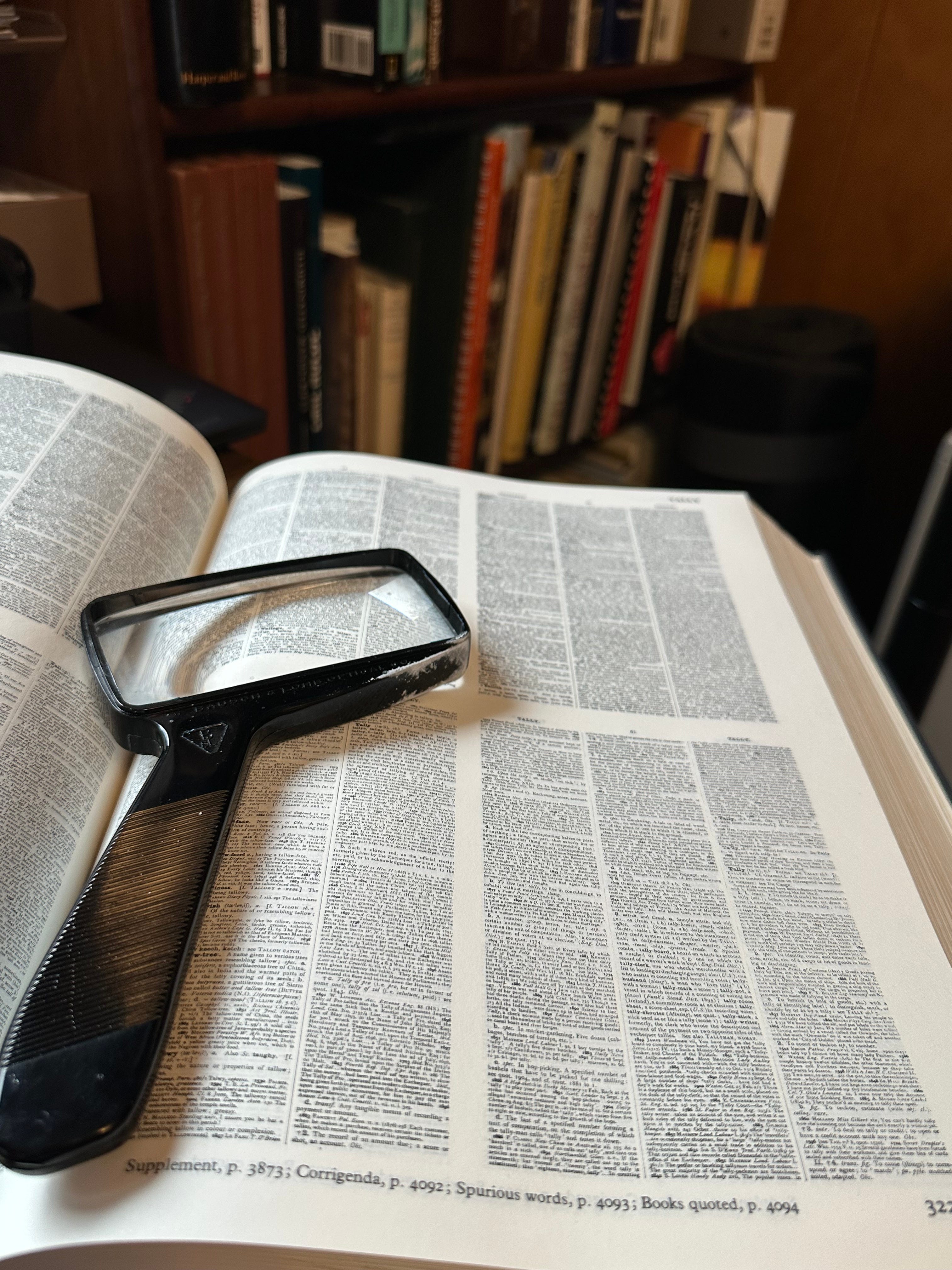
Several years ago, I was invited to be a judge in a short-story writing competition offered by our local library. It was restricted to writers over the age of fifty, as it was felt that the life experience of older writers would yield a more mature and reflective quality of work than that of younger writers. Judges were expected to be ‘published authors,’ and to have had some experience in judging work of literary merit. I qualified. As a high-school teacher of English, I had edited the work of some five thousand students during my years in the classroom. The painstaking and time-consuming work of correcting mechanical and stylistic errors, substituting a more effective word or phrase in place of defective diction, assessing organization and logic in the development of narrative or argument, detecting plagiarism or noting a failure to make good use of evidence in essays, and providing constructive criticism, including fulsome praise where warranted, is more akin to editing than to ‘marking,’ with which it is all too often confused, to the chagrin of most conscientious English teachers.
I enjoyed being a judge.
For several years until library authorities decided the age limit was exclusionary and decided to replace the competition with one that did away with that limit, we prepared interested competitors by sharing with them our experiences of judging, and presiding over animated discussions about the evaluation criteria and guidelines for the contest, about what constitutes effective stories, their types and traits, sources of authorial inspiration, and the importance of accepting that writing is often a necessarily frustrating process involving frequent re-writing and revision. We then met to read and compare anonymous selected stories from among the entries and advocate for the best ones. Our judgments were remarkably similar. My colleagues were writers, teachers, and academics. I like to think we all learned from one another.
An effective short story is one that is not only well-written, but also compelling, convincing, and memorable. Such a story compels the reader’s attention and interest, in some cases holding him or her enthralled. A thrall is a lovely Anglo-Saxon word meaning a captive, hence a reader or viewer is held captive by the author’s power, so much so that he cannot, for example, hear or heed the call to the dinner table. A good short story must also convince the reader that the story could happen or could have happened, and persuade him that the characters, setting, and events are similarly believable. A convincing character in the story would act in such a way, would say what she says, would do what she does. The story causes the reader to employ what the poet Coleridge called ‘a willing suspension of disbelief,’ when we temporarily suspend our critical faculties by persuading ourselves that what we are being exposed to is real, and not merely ‘make believe,’ just as an actor does on the stage when he assumes the role of a fictional character. If the story is very good, it will also be memorable. We will want to remember it, reflect on it, talk about it enthusiastically with our friends, and encourage them to read it for themselves. All three components make up that crucially indispensable word ‘impact.’ Stories with impact have staying power, which is why fairy tales, parables, folk tales and fables have lasted for centuries.
One such story with commendable impact is called ‘Something Important.’ It deservedly won its author a prize in the library’s competition in 2015. In the story, a would-be writer, the mother of two young girls, seeks respite from domestic duties during the summer holidays so she can write undisturbed. She hires an unprepossessingly taciturn babysitter to take full-time care of the girls while she tries in vain to write, but is forced to realize that by doing so, she has neglected ‘something important’ in the lives of her daughters in the process, and has frittered away the time she might have used to bond with them. When I met the author in person some months later, I praised her story for its understated subtlety in depicting devastating loss, its understanding of human nature, and its clever use of the contrast between the mother’s pride in and obsession with words on the one hand, and the babysitter’s scorned wordlessness on the other, yet it is the babysitter who is the girls’ confidante that summer and not their mother. As is often the case with these submissions, this particular story was inspired by the author’s real-life experience in a small northern town where she had met the babysitter’s prototype, and had been haunted by the memory of that encounter ever since. She said she simply had to put her into a story.
Contestants were encouraged to reach into their pasts for an incident or person whose influence in their lives had been considerable. There was endless variety in the submissions: pathos, humour, love, fear, courage, resignation, triumph and loss. Many were interesting; the best were outstanding. I found a troubling consistency one year in a number of vivid accounts about the harshness of life on the Ontario farms of a generation or more ago. These stories poignantly described lives of isolation, alcoholism, and privation, and all appeared to have been written by long-suffering farmers’ wives. Writing a story about an important incident is often therapeutic, even if the writing of it does not win a prize. Most entries in competitions don’t.
Sometimes, regrettably, the impact of some stories was compromised by a lack of fluency, implying that the writer’s native language was not English. As a former ESL teacher, I could sometimes detect idiosyncratic quirks of expression that would not have appeared in the work of a native speaker. One story, set in Jamaica, concerned a grandmother’s attempt to find a cure for a grandson’s ailment from a quack ‘magician’ in the remote interior of the island. The originality of the story and the exotic nature of the quest were fascinating and undoubtedly authentic, but its virtues were unfortunately insufficient to compensate for the numerous writing errors that made parts of the story at times incomprehensible. It was disappointingly frustrating to read, and so the story lost the audience it might have had. What the writer needed was tutorial assistance, but no remedial action could be suggested because the anonymity of all submissions except those of the winning entries was guaranteed by the rules of the competition.
A frustration that judges kept encountering was the failure of contestants to understand what a short story is, despite the library’s offer of a preparatory introduction for all contestants. It was as if they had never read a good one. Among the submissions was a precis of a government report. It was, predictably, achingly dull. Another, presumably also written by a public servant, was an angry justification for a program discontinued by a newly-elected government with different priorities. It was entertaining to read of the author’s indignation, but it was not a story. A bureaucratic mind is not a storyteller’s. I recall receiving pieces of unfocused nostalgia, probably from older writers, in which the simplicities of a bygone age were described with warmth and empathy, but these also were not stories, with a clear beginning, development and satisfying conclusion: they were sadly incomplete, as in a telephone conversation suddenly cut off. Some stories were eminently forgettable. One was crudely obscene. Others, intended to be comic, were not. One such depicted a wheelchair race between two old men in a retirement home. The premise was amusing, but the story was ruined by grotesque exaggeration: the story ended abruptly in the unconvincing smashing of crockery and the wholesale destruction of the dining room and both wheelchairs. Even the most unimpeded wheelchair is not a Ferrari. This story, I subsequently learned, was plagiarized. The original, so much better, was shorter, understated, and included a deft reference, in an unexpected ending, to the appearance of a challenger in a motorized wheelchair. Plagiarism is a serious offence. As Duddy Kravitz memorably said, although in a very different context, “Cheaters never prosper!”
Another story, undoubtedly well-meant but also unrealistic, was about a female suicide bomber who is instructed to blow up Ottawa’s Notre Dame Cathedral. It is not clear why terrorists would have chosen such a mission to such a place, or such a person to carry out this act. The bomber boards an Air Canada flight from the Middle East, an undetected bomb in her luggage, and is pleasantly surprised to discover that the Canadian male sitting next to her on the plane is courteous and tolerant. She has an animated civil discussion with him. She is later perplexed to find out that the taxi driver who takes her downtown is of Arabic descent, loves Canada, and is equally tolerant and polite. Yet she plans to murder people like these. The story concludes with her on the sidewalk outside the cathedral giving some sober second thought to her mission. Whether the bomb is still ticking in her carry-on while she re-considers is unclear, but the cathedral is still standing by story’s end. If only, the author implies with touching John Lennon-like naivete, if only terrorists could see us as we really are, bad things would not happen, and sunny ways would be the inheritance of us all…
Timeless advice applies to all who seek to write well. Take mental snapshots of memorable events, then record them in a journal. Pay attention to detail. Keep a diary. Write for yourself first, and for others second. Show: don’t tell, explain, or preach. Revise and proof-read. Let a trusted but constructively critical reader see what you have written. Respect your readers. Don’t bore them with dull long-winded description or dialogue that adds nothing to the story. Reflect often, and in solitude. Don’t force a story; let it come to you. Read. Heed the warning of Stephen King below. His bestselling horror stories have sealed his reputation as a writer of considerable skill. All of us, novice writers especially, need to read widely and frequently. This is the best way to learn how to write what is compelling, convincing, and memorable. Reading and writing are two sides of the same coin. Good stories last for good reason. I once produced a list of time-tested good stories for contestants, and would happily make it available to any interested reader. Mr. King said this: “If you don’t have the time to read, you don’t have the time (or the tools) to write. Simple as that.”
 | A guest post by
|